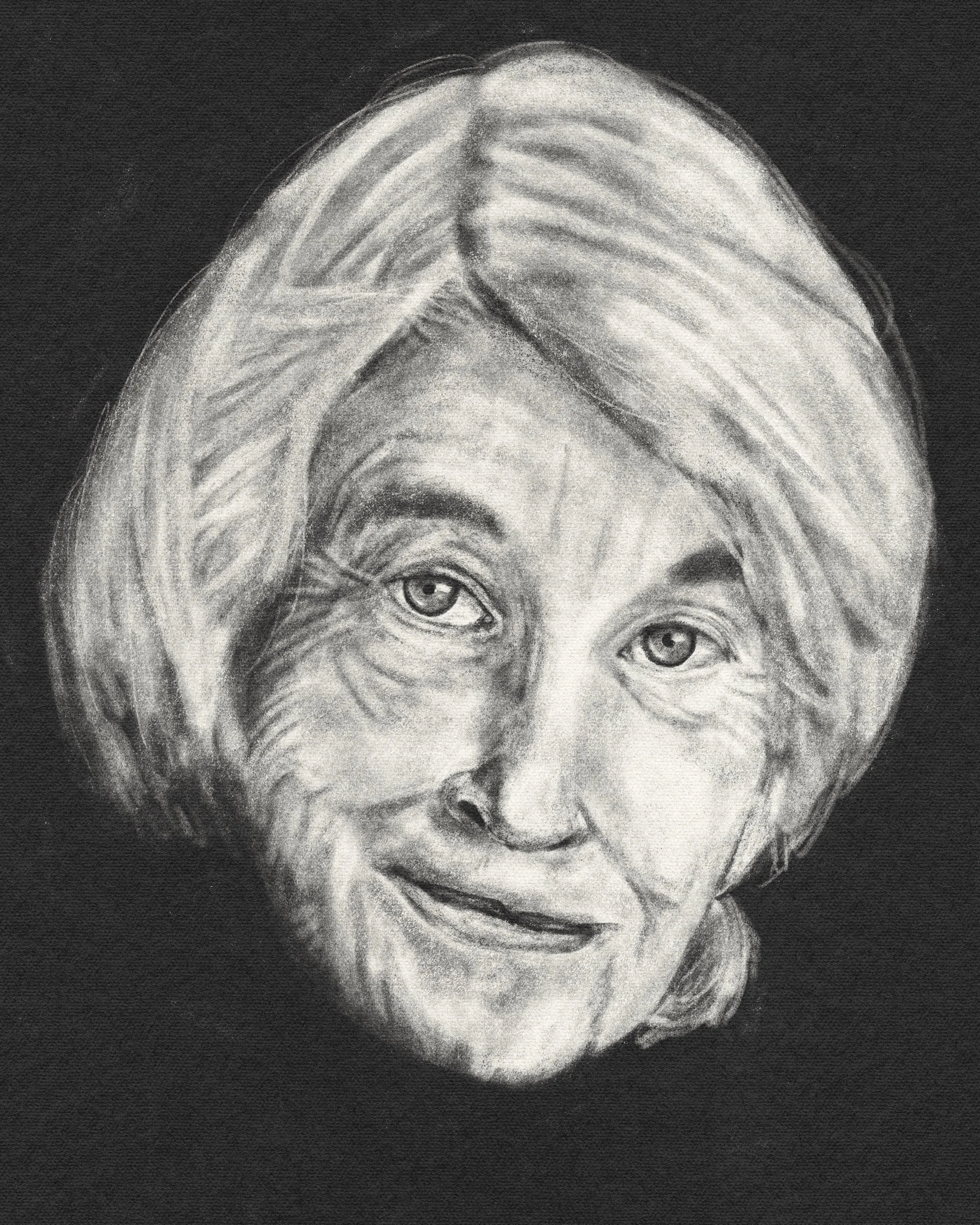
Mary Oliver, sketch by Erica Williams
For the past few weeks, the poem Flare by the beloved poet Mary Oliver has come to mind while I am going about my day. It’s not unusual for one of her poems to resonate with me. Anyone who has ever read Wild Geese or The Journey, two of her most well-known poems,likely finds themselves ruminating on her timeless words that seem to have been written just for them. Her poems lack ego and hubris, and are instead rooted in the human condition - joy, grief, longing, hope, despair, resilience, and awe of the natural world flow from her mind to the page as she makes sense of the world and her place in it.
In Flare, Oliver recalls her difficult childhood of wandering away from the noise of adults to the solitude of quiet spaces where she is alone and unafraid. Her parents are weighed down by the griefs of their own lives, and thought they are terminally unhappy and angry, they refuse to release the weight of their hardships.
In the poem, their bitterness blinds them to the wounds they create in their child’s life, driving young Mary to seek solace in an empty barn still filled with the scents of cows and milk and ammonia. She daydreams of a better family, one that misses her while she is away, saving her a seat at the table when she finally returns due to the pangs of hunger, an uncle patting her on the shoulder with a warm welcome back into the fold of a happy family that has replaced her own. Even a hopeful child knows that daydreams are not reality, a fact that is a burden in itself. And young Mary suddenly faces this with us as she sets her own grief free, something her parents were never able to do even though it destroyed them.
She resolves to release her mother and father to the earth, and along with them she buries their burdens and refuses to carry them with her into her life. Her life is her own, finally. She will not carry their weight, and will instead nurture her curiosity of the natural world, the only world that has ever offered her the solace she so desperately longed for.
I once carried the weight of many burdens that were not my own but were handed down from one generation to the next. I, too, have stood in the field and scattered my flowers, buried the grief in the earth, walked away. I felt that weight even after I left, though it slowly lifted away the further I walked. But even today, years later, grief will pulse electrically though my body unexpectedly and cause an aching pain that feels as if all my limbs have been wildly swinging at nothing and everything.
We are all broken in our way, and I believe that much of the brokenness we feel stems from the patterns we are unwittingly born into. And while we can recognize that those that came before us likely felt as broken as we sometimes feel, it is fair to say that they made the choice on what they continued to carry and what they refused to pass down.
The pain that was handed to me as a child and into late adulthood was never mine to carry. That pain was passed along to my brothers and sister as well, and their lives have been far harder than they should have ever been as they have yet to understand that they can let it go. Unfortunately for many like my siblings, the weight of those before us becomes all they know, and letting go feels like losing themselves entirely.
The poem leaves us with sage advice that is a frequent theme in Oliver’s poems - go out into Nature when loneliness and grief visit you. They can be frequent visitors, and so learn how to connect with the natural world that invites you over and over into its open arms. Become a resident in the world that offers you the delicate wings of the green moth, the tambourine sound of the snow-cricket, hummingbirds with water-sparks in their wings, and summer rain. Keep going, keep getting up.
And read more Mary Oliver.
Flare by Mary Oliver
1.
Welcome to the silly, comforting poem.
It is not the sunrise,
which is a red rinse,
which is flaring all over the eastern sky;
it is not the rain falling out of the purse of God;
it is not the blue helmet of the sky afterward,
or the trees, or the beetle burrowing into the earth;
it is not the mockingbird who, in his own cadence,
will go on sizzling and clapping
from the branches of the catalpa that are thick with blossoms,
that are billowing and shining,
that are shaking in the wind.
2.
You still recall, sometimes, the old barn on your
great-grandfather's farm, a place you visited once,
and went into, all alone, while the grownups sat and
talked in the house.
It was empty, or almost. Wisps of hay covered the floor,
and some wasps sang at the windows, and maybe there was
a strange fluttering bird high above, disturbed, hoo-ing
a little and staring down from a messy ledge with wild,
binocular eyes.
Mostly, though, it smelled of milk, and the patience of
animals; the give-offs of the body were still in the air,
a vague ammonia, not unpleasant.
Mostly, though, it was restful and secret, the roof high
up and arched, the boards unpainted and plain.
You could have stayed there forever, a small child in a corner,
on the last raft of hay, dazzled by so much space that seemed
empty, but wasn't.
Then--you still remember--you felt the rap of hunger--it was
noon--and you turned from that twilight dream and hurried back
to the house, where the table was set, where an uncle patted you
on the shoulder for welcome, and there was your place at the table.
3.
Nothing lasts.
There is a graveyard where everything I am talking about is,
now.
I stood there once, on the green grass, scattering flowers.
4.
Nothing is so delicate or so finely hinged as the wings
of the green moth
against the lantern
against its heat
against the beak of the crow
in the early morning.
Yet the moth has trim, and feistiness, and not a drop
of self-pity.
Not in this world.
5.
My mother
was the blue wisteria,
my mother
was the mossy stream out behind the house,
my mother, alas, alas,
did not always love her life,
heavier than iron it was
as she carried it in her arms, from room to room,
oh, unforgettable!
I bury her
in a box
in the earth
and turn away.
My father
was a demon of frustrated dreams,
was a breaker of trust,
was a poor, thin boy with bad luck.
He followed God, there being no one else
he could talk to;
he swaggered before God, there being no one else
who would listen.
Listen,
this was his life.
I bury it in the earth.
I sweep the closets.
I leave the house.
6.
I mention them now,
I will not mention them again.
It is not lack of love
nor lack of sorrow.
But the iron thing they carried, I will not carry.
I give them--one, two, three, four--the kiss of courtesy,
of sweet thanks,
of anger, of good luck in the deep earth.
May they sleep well. May they soften.
But I will not give them the kiss of complicity.
I will not give them the responsibility for my life.
7.
Did you know that the ant has a tongue
with which to gather in all that it can
of sweetness?
Did you know that?
8.
The poem is not the world.
It isn't even the first page of the world.
But the poem wants to flower, like a flower.
It knows that much.
It wants to open itself,
like the door of a little temple,
so that you might step inside and be cooled and refreshed,
and less yourself than part of everything.
9.
The voice of the child crying out of the mouth of the
grown woman
is a misery and a disappointment.
The voice of the child howling out of the tall, bearded,
muscular man
is a misery, and a terror.
10.
Therefore, tell me:
what will engage you?
What will open the dark fields of your mind,
like a lover
at first touching?
11.
Anyway,
there was no barn.
No child in the barn.
No uncle no table no kitchen.
Only a long lovely field full of bobolinks.
12.
When loneliness comes stalking, go into the fields, consider
the orderliness of the world. Notice
something you have never noticed before,
like the tambourine sound of the snow-cricket
whose pale green body is no longer than your thumb.
Stare hard at the hummingbird, in the summer rain,
shaking the water-sparks from its wings.
Let grief be your sister, she will whether or no.
Rise up from the stump of sorrow, and be green also,
like the diligent leaves.
A lifetime isn't long enough for the beauty of this world
and the responsibilities of your life.
Scatter your flowers over the graves, and walk away.
Be good-natured and untidy in your exuberance.
In the glare of your mind, be modest.
And beholden to what is tactile, and thrilling.
Live with the beetle, and the wind.
This is the dark bread of the poem.
This is the dark and nourishing bread of the poem.
From The Leaf and the Cloud (Da Capo Press, 2000
