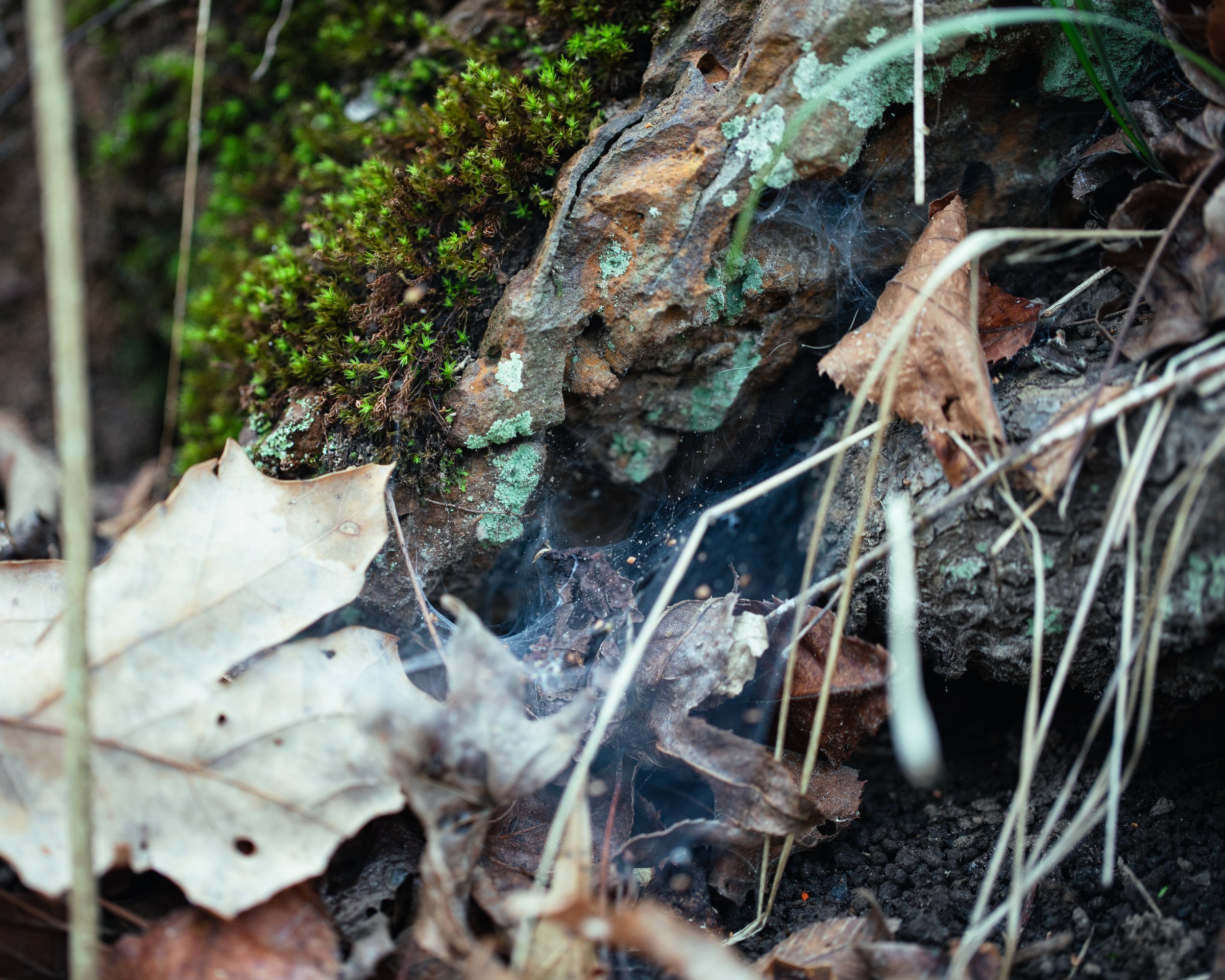
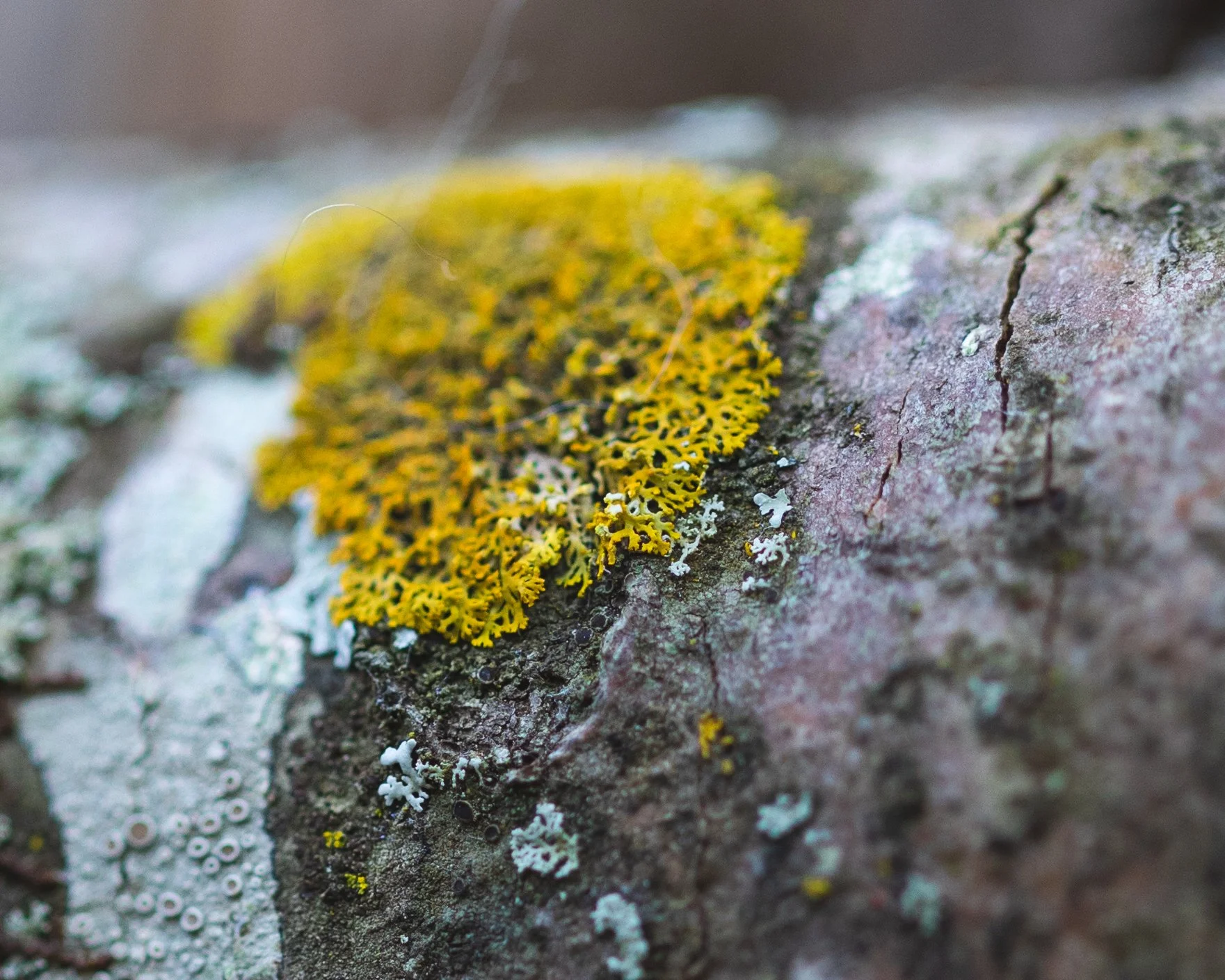
I am silent as I kneel at the altar made of sandstone, root, and earth wedged into the side of a cut into a hill along a trail in our woods. A blanket of moss gives way to iron-rich sandstone splashed with crustose lichens in shades of aqua and seafoam that brighten the roof of a funnel web woven by spider hidden from view. A hairy woodpecker responds to the calls of a barred owl, alerting other small creatures of a predator in their midst as I narrow my focus from worries and fears to the peacefulness of the moment.
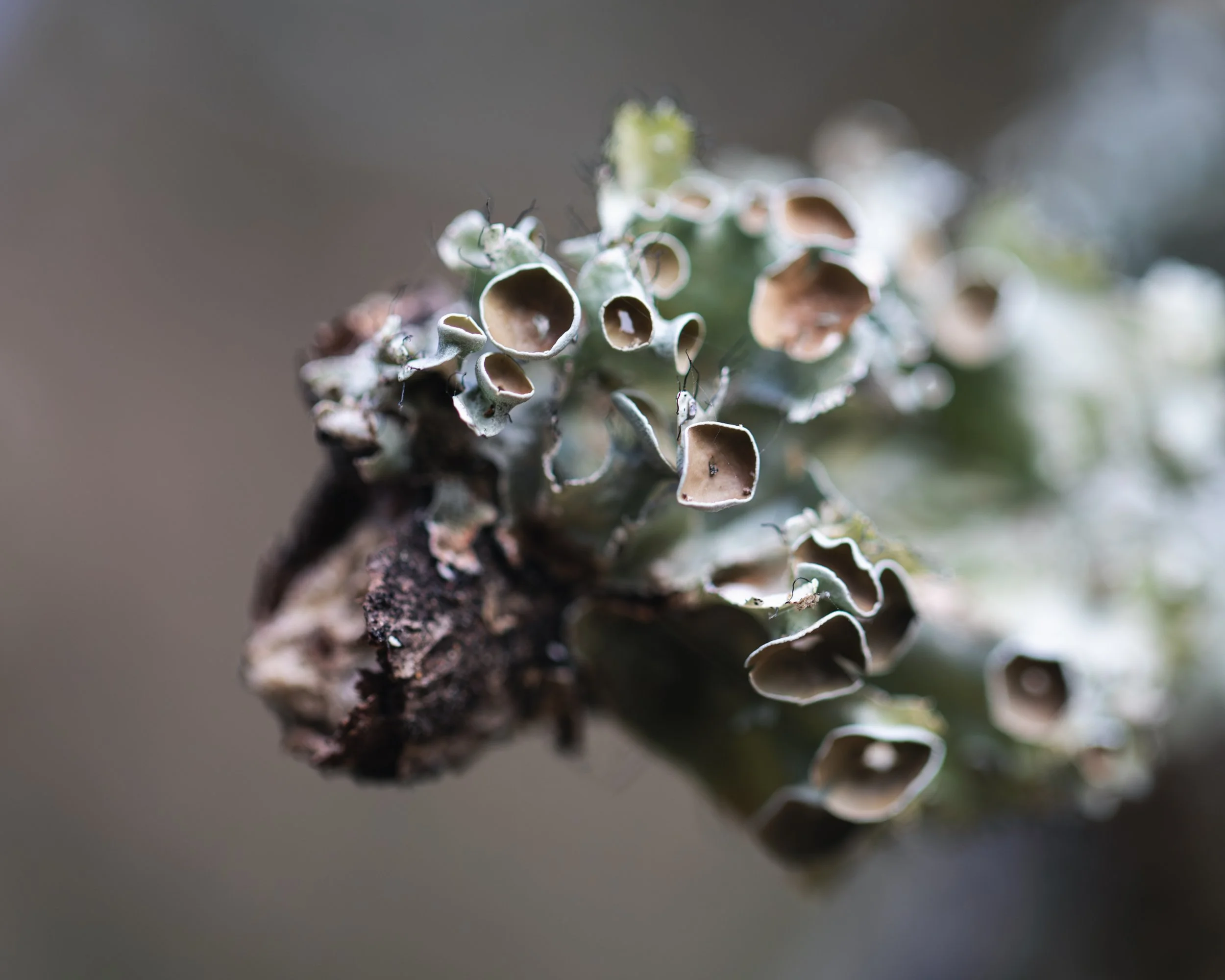
For years, I have observed this particular small space tucked into the hill, a place that only I know so well. It is a microcosm of the woods, a microecosystem that is home to an ever-changing melange of life that becomes much more evident under a hand lens or through the view of a camera’s macro lens. Every square inch is covered in life. As I focus my attention here, it is the lichens that draw my attention.
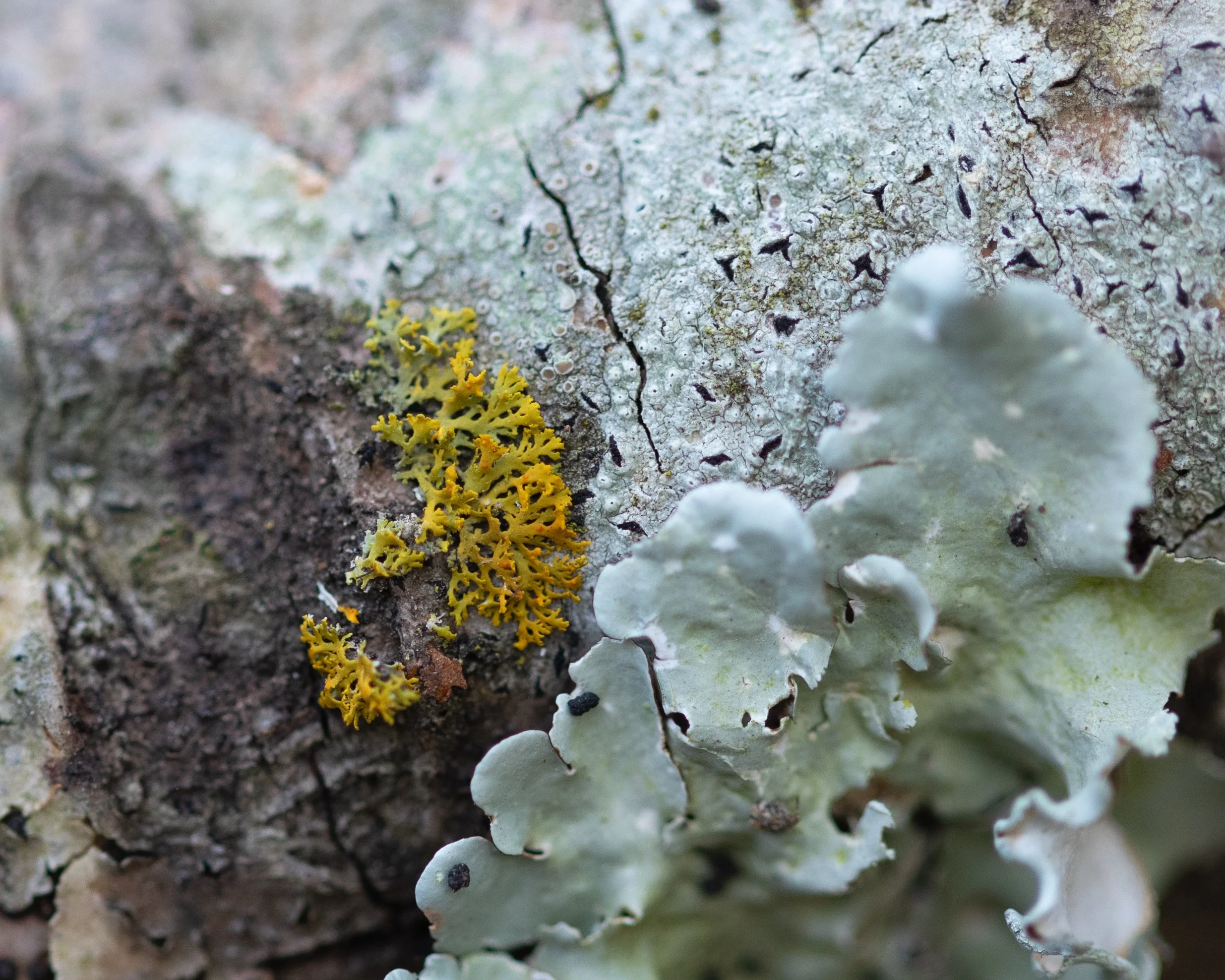
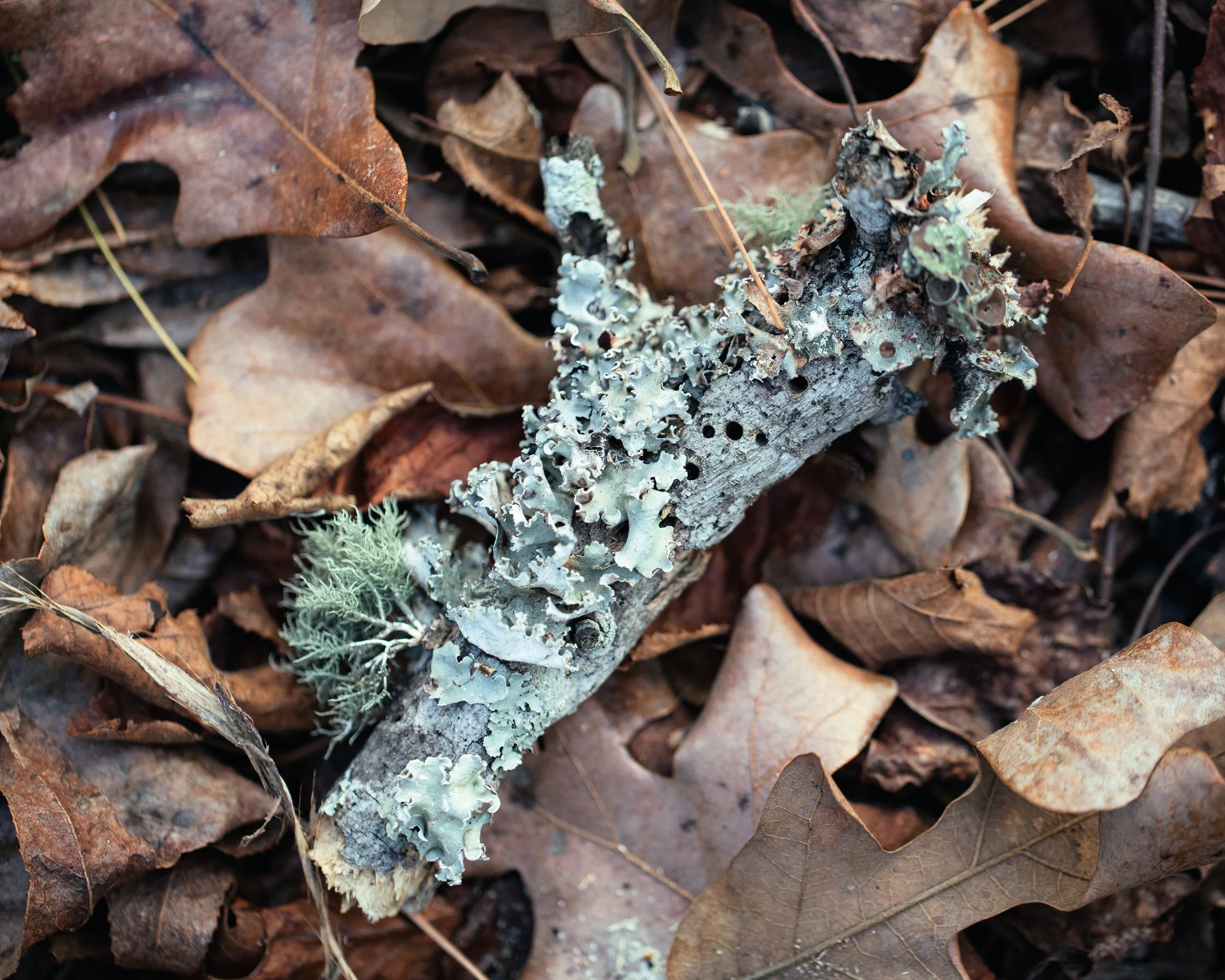
Lichens are everywhere in these woods – on rocks, on tree trunks and limbs, tossed into the leaf litter – in all its forms and sizes. In spite of (or perhaps due to) their ubiquitousness, they are easy to overlook for all of the larger nature they live within. They exist quietly wherever they grow, rootless and passive as they take what they need to live from the air, rain, and sun. While our woods are located within a humid subtropical climate that provides a more than suitable habitat for them, certain lichen species, when dry, can survive extremely high temperatures (close to 200°F), while other may be frozen at temperatures of -320°F and survive after thawing. It may be surprising to learn that lichens are the dominant vegetation in the coldest parts of the Arctic and Antarctica, and in some of the hottest deserts and highest mountain peaks.
Since learning many years ago that lichens are not a single organism but instead are composites of fungi and either algae or cyanobacteria, lichens have been a source of fascination for me. On its own, fungi cannot make its own food and must instead gain its nutrients from organic matter such as decaying wood and leaves. In contrast, algae and cyanobacteria are capable of photosynthesis, the process in which an organism converts sunlight, carbon dioxide, and water into sugars that serve as food.
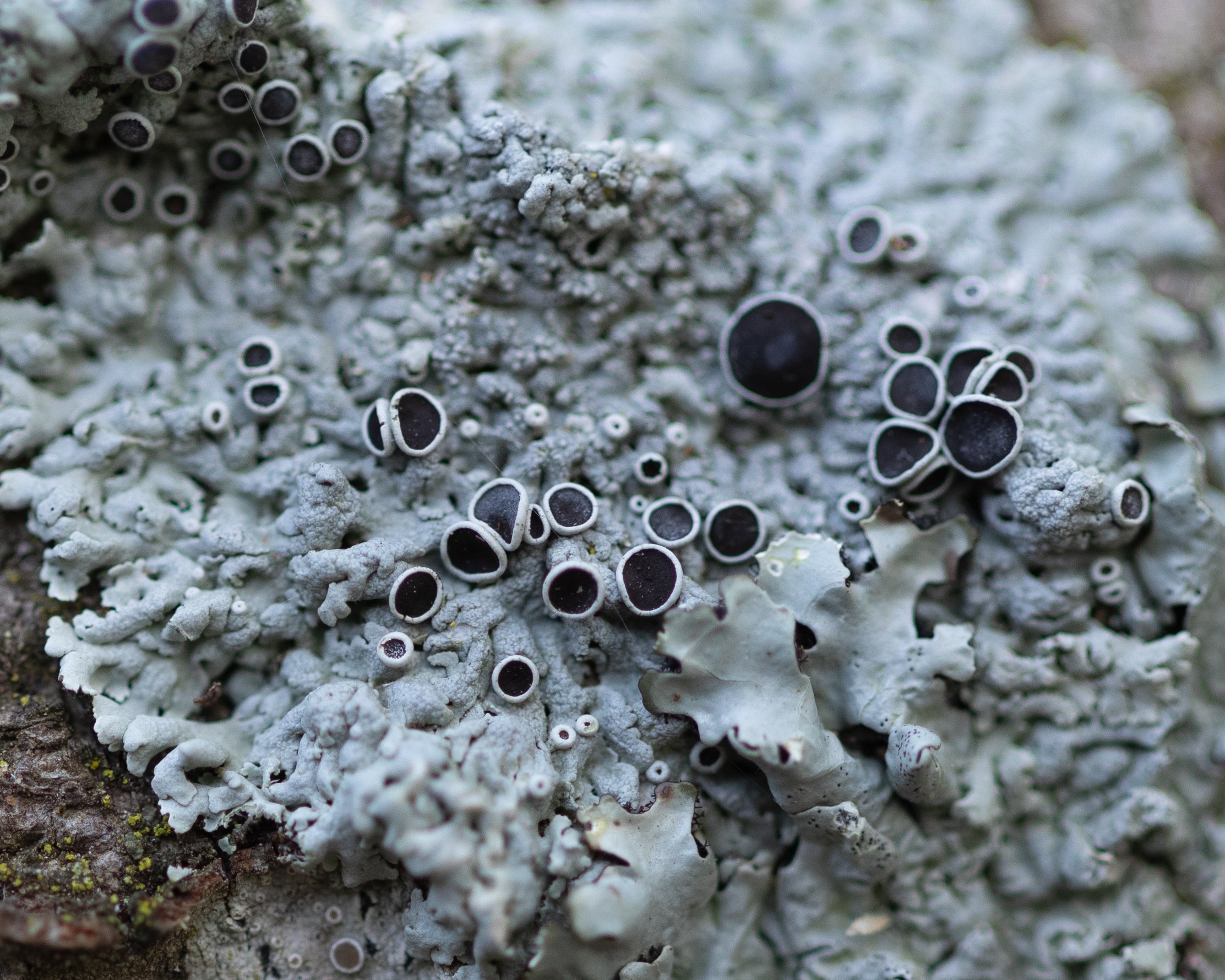
In its simplest form, a lichen is a dual organism comprised of a fungus that has enveloped an alga or cyanobacteria that then exist together in a symbiotic relationship where the fungus provides a safe living place for the alga/cyanobacteria, which in turn provides food for both through photosynthesis. Due to their confinement within the fungus, the alga/cyanobacteria species’ growth is limited, which also limits the growth of the entire lichen as the two components grow at a pace that maintains a balance so that one does not outgrow the other.
It is this relationship that I find captivating. There is some debate among scientists that study lichens on whether the relationship is truly symbiotic. The way in which a lichen is formed (lichenization) seems to counter the defining characteristic of mutualistic symbiosis that both organisms benefit from the relationship. Upon identifying a compatible alga or cyanobacteria, the fungus penetrates the cells walls of the alga/cyanobacteria, which in turn sets off a reaction in the alga/cyanobacteria cell that causes its walls to become more permeable, allowing the carbohydrates it produces during photosynthesis to leak out and become absorbed by the fungus. While the alga/cyanobacteria still retains enough food for its own use, many alga/cyanobacteria cells are killed during the process of lichenization.
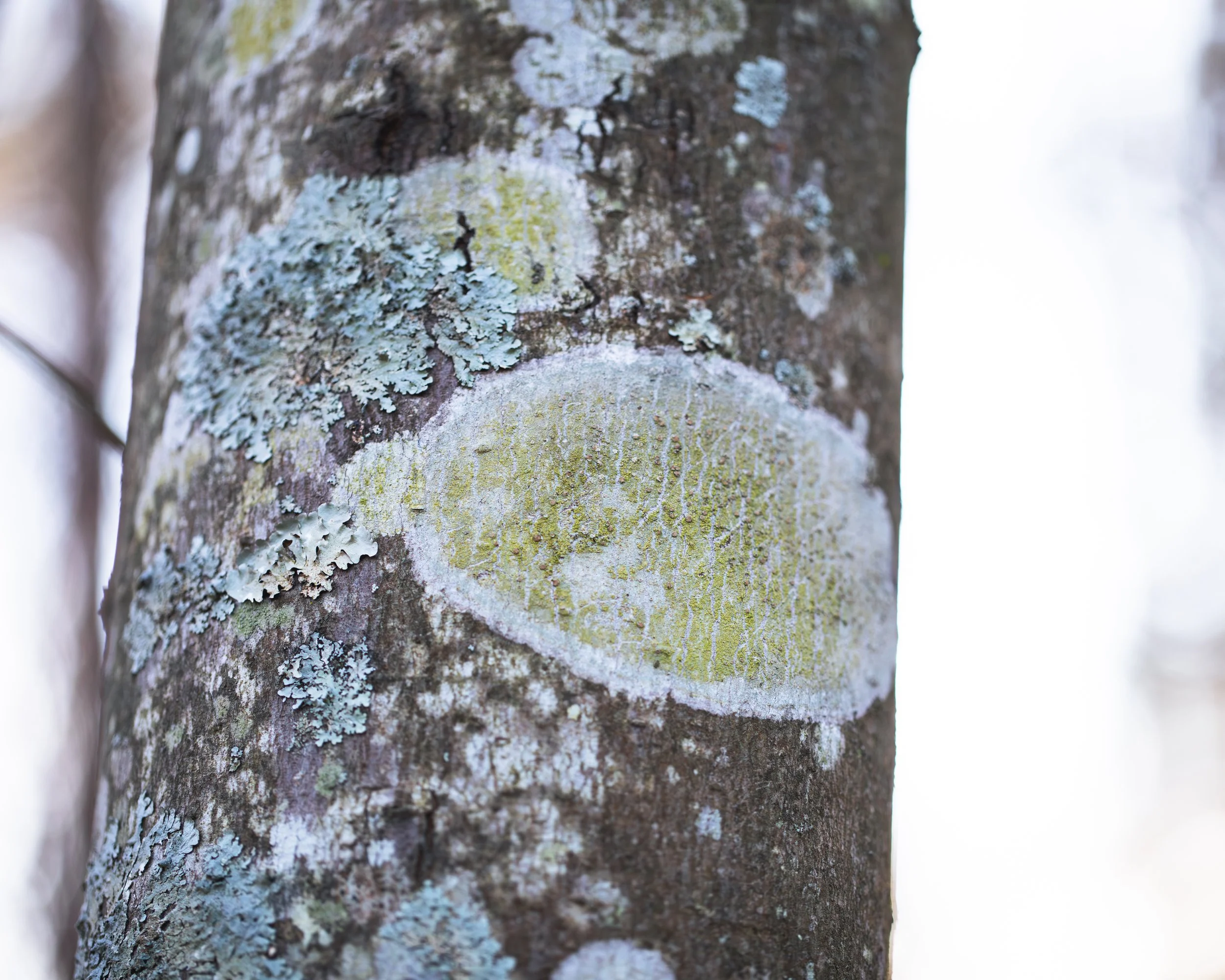
For this reason along with the inability of the alga/cyanobacteria to sexually reproduce upon lichenization, some believe the relationship to instead be a form of mild parasitism in which the fungus benefits more from the relationship than the alga/cyanobacteria. However, it must be understood that this relationship benefits the alga/cyanobacteria in a critical way by allowing it to grow in locales and on substrates that it would not be able to survive on its own.
No matter the type of relationship, the fact that dissimilar species can interact with each other in such a way as to form something entirely new and unlike themselves with the ability to thrive in almost any environment is nothing short of amazing. The specks of lichen on the sandstone rocks nestled into the side of the hill are more than first meets the eye. They are entanglements that go back to at least the Triassic period 250 million years, a community that has figured out a way to work with one another to survive in even the most unlikely places and situations.
I am still kneeling on the soft earth as the sun goes deeper into the horizon beyond the hill, the light fading quickly in the winter sky, when I realize that all that I know about lichens is not enough. I pack up my camera and tripod, take another look around to savor what I cannot bring with me except for in spirit, and head home to begin a new project.
© 2026 Writ Wild. Share permitted with clear credit and no modifications. All other rights reserved.
